Friday, July 09, 2021

#institutes [II]

Select Quotes from John Calvin's 'The Institutes of the Christian Religion'
All quotes below are from Book One: Chapters 6-10


~  Chapter Six  ~

On the Necessity of Revelation for Knowing God. '[It] is not strange that those who are born in darkness become more and more hardened in their stupidity; because the vast majority instead of confining themselves within due bounds by listening with docility to the Word, exult in their own vanity. If true religion is to beam upon us, our principle must be, that it is necessary to begin with heavenly teaching, and that it is impossible for any man to obtain even the minutest portion of right and sound doctrine without being a disciple of Scripture.'

On the Necessity of Revelation for Knowing God (II): '[If] we reflect how prone the human mind is to lapse into forgetfulness of God, how readily inclined to every kind of error, how bent every now and then on devising new and fictitious religions, it will be easy to understand how necessary it was to make such a depository of doctrine as would secure it from either perishing by the neglect, vanishing away amid the errors, or being corrupted by the presumptuous audacity of men.'


~  Chapter Seven  ~ 

A Justification of New Testament Canon. 'Paul testifies that the Church is “built on the foundation of the apostles and prophets,” (Eph. 2:20). If the doctrine of the apostles and prophets is the foundation of the Church, the former must have had its certainty before the latter began to exist. Nor is there any room for the cavil, that though the Church derives her first beginning from thence, it still remains doubtful what writings are to be attributed to the apostles and prophets, until her Judgment is interposed.'

How the Spirit is Arbiter of Scriptures' Authenticity. 'Profane men think that religion rests only on opinion, and, therefore, that they may not believe foolishly, or on slight grounds, desire and insist to have it proved by reason that Moses and the prophets were divinely inspired. But I answer, that the testimony of the Spirit is superior to reason. For as God alone can properly bear witness to his own words, so these words will not obtain full credit in the hearts of men, until they are sealed by the inward testimony of the Spirit.'

Spiritual Enlightenment as Testimony to Scriptures' Authenticity. 'Some worthy persons feel disconcerted, because, while the wicked murmur with impunity at the Word of God, they have not a clear proof at hand to silence them, forgetting that the Spirit is called an earnest and seal to confirm the faith of the godly, for this very reason, that, until he enlightens their minds, they are tossed to and fro in a sea of doubts... Enlightened by him, we no longer believe, either on our own Judgment or that of others, that the Scriptures are from God; but, in a way superior to human Judgment, feel perfectly assured—as much so as if we beheld the divine image visibly impressed on it—that it came to us, by the instrumentality of men, from the very mouth of God.'

The Living Energy of the Living Word. '[We] have a thorough conviction that, in holding [Scripture], we hold unassailable truth; not like miserable men, whose minds are enslaved by superstition, but because we feel a divine energy living and breathing in it—an energy by which we are drawn and animated to obey it, willingly indeed, and knowingly, but more vividly and effectually than could be done by human will or knowledge. Hence, God most justly exclaims by the mouth of Isaiah, “Ye are my witnesses, saith the Lord, and my servant whom I have chosen, that ye may know and believe me, and understand that I am he,” (Isa. 43:10).'

Spiritual Enlightenment Given Only to the Elect. '[The] only true faith is that which the Spirit of God seals on our hearts. Nay, the modest and teachable reader will find a sufficient reason in the promise contained in Isaiah, that all the children of the renovated Church “shall be taught of the Lord,” (Isaiah 54:13). This singular privilege God bestows on his elect only, whom he separates from the rest of mankind. For what is the beginning of true doctrine but prompt alacrity to hear the Word of God?'

Spiritual Enlightenment is a Gift of God. 'God having been pleased to reserve the treasure of intelligence for his children, no wonder that so much ignorance and stupidity is seen in the generality of mankind. In the generality, I include even those specially chosen, until they are ingrafted into the body of the Church. Isaiah, moreover, while reminding us that the prophetical doctrine would prove incredible not only to strangers, but also to the Jews, who were desirous to be thought of the household of God, subjoins the reason, when he asks, “To whom has the arm of the Lord been revealed?” (Isaiah 53:1). If at any time, then we are troubled at the small number of those who believe, let us, on the other hand, call to mind, that none comprehend the mysteries of God save those to whom it is given.'


~  Chapter Eight  ~

The Victory of Scripture as Testifying to its Authenticity. 'It' is not to be accounted of no consequence, that, from the first publication of Scripture, so many ages have uniformly concurred in yielding obedience to it, and that, notwithstanding of the many extraordinary attempts which Satan and the whole world have made to oppress and overthrow it, or completely efface it from the memory of men, it has flourished like the palm tree and continued invincible. Though in old times there was scarcely a sophist or orator of any note who did not exert his powers against it, their efforts proved unavailing. The powers of the earth armed themselves for its destruction, but all their attempts vanished into smoke. When thus powerfully assailed on every side, how could it have resisted if it had trusted only to human aid? Nay, its divine origin is more completely established by the fact, that when all human wishes were against it, it advanced by its own energy.'

The Victory of Scripture in Capturing Kingdoms. 'Add that it was not a single city or a single nation that concurred in receiving and embracing it. Its authority was recognised as far and as wide as the world extends—various nations who had nothing else in common entering for this purpose into a holy league.'

The Authenticity of Scripture Verified by Blood. '[With] what confidence does it become us to subscribe to a doctrine attested and confirmed by the blood of so many saints? They, when once they had embraced it, hesitated not boldly and intrepidly, and even with great alacrity, to meet death in its defence. Being transmitted to us with such an earnest, who of us shall not receive it with firm and unshaken conviction? It is therefore no small proof of the authority of Scripture, that it was sealed with the blood of so many witnesses, especially when it is considered that in bearing testimony to the faith, they met death not with fanatical enthusiasm (as erring spirits are sometimes wont to do), but with a firm and constant, yet sober godly zeal.'

The Final Proof of Scripture is the Spirit of God. 'There are other reasons, neither few nor feeble, by which the dignity and majesty of the Scriptures may be not only proved to the pious, but also completely vindicated against the cavils of slanderers. These, however, cannot of themselves produce a firm faith in Scripture until our heavenly Father manifest his presence in it, and thereby secure implicit reverence for it. Then only, therefore, does Scripture suffice to give a saving knowledge of God when its certainty is founded on the inward persuasion of the Holy Spirit.'


~  Chapter Ten  ~

The Knowledge of God Prompts Worship, Obedience, and Dependence Upon God. '[The] knowledge of God, which is set before us in the Scriptures, is designed for the same purpose as that which shines in creation—viz. that we may thereby learn to worship him with perfect integrity of heart and unfeigned obedience, and also to depend entirely on his goodness.'


Monday, July 05, 2021

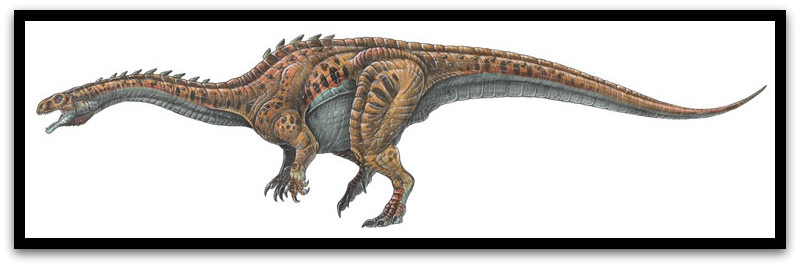
Dino of the Week: Massospondylus


Type Species: Massospondylus carinatus
Classification: Dinosauria - Saurischia - Sauropodomorpha - Prosauropoda
Time Period: Early Jurassic
Location: Africa & North America
Diet: Herbivore

This Lower Jurassic dinosaur has been found in Africa and North America. Stretching to between 15-20 feet, Massospondylus was smaller than many of the larger prosauropods that preceded it by millions of years. This dinosaur had a body kept long and low, and it stood no higher than five feet tall at the hips. Its body may have been smaller than its predecessors, but its neck was longer, made so by its neck vertebrae being four times long as they were wide (the presence of these elongated vertebrae gives the meaning of Massospondylus’ name: “the Longer Vertebrae”). The extra-long neck and long tail served as bookends for its bulky, low-slung body. Rounded, peg-like teeth designed for stripping leaves off trees lined the jaws of its small head. Massospondylus’ forelegs were half the length of the hind limbs, but they were by no means scrawny: the broad upper end of the humerus implies that these fore-arms had strong muscle attachments and could deliver a fatal punch. Such a “killer punch” would’ve been made that much more lethal by the gruesome thumb claw on each large hand. Though it was long thought that Massospondylus was confined to a quadrupedal stance, recent studies have shown that it could walk on two legs if it so desired.


The presence of a few large holes for blood vessels on the surface of the jaw bones implies that it had, like many prosauropods, cheeks (reptiles without cheeks have numerous small blood vessel holes in the jaws rather than a few large ones); these cheeks helped keep food from falling out of the mouth. Some scientists have speculated that Massospondylus may have had a beak, like the ornithischians, but the evidence for this is dubious at best. On the subject of its dietary apparatuses, it seems Massospondylus employed a gastric mill: a specimen from Zimbabwe was found with gastroliths in its gut area, and these particular stones had their origin nearly twelve miles from the gravesite. This specimen had probably ritualistically swallowed gizzard stones only hours or days before its death. 

Like Plateosaurus, Massospondylus possessed small air cavities in some of its bones. Most saurischian dinosaurs had these hollowed-out cavities (called pneumatic foramina) that served as a rudimentary “flow-through ventilation system” similar to that of present-day birds. The neck vertebrae and ribs are hollowed out by the cervical air sack; the upper back vertebrae, by the presence of the lungs; and the lower back and hip vertebrae by the abdominal air sack. Prosauropods are the only major group of saurischian dinosaurs that lack an extensive system of pneumatic foramina, despite some species—such as Massospondylus—possessing the miniscule “building-blocks” that could, one day, blossom into full-blown pneumatic foramina. The presence of air sacs in Massospondylus doesn’t mean that it had a full-blown pneumatic system like that of birds (or even like that of wider saurischian); it does mean that, at the least, we have glimpses of the plodding evolution of such structures. 

The remains of nearly eighty individuals have been unearthed, indicating that Massospondylus may have engaged in gregarious behavior, traveling in herds throughout both Laurasia and Gondwana. Such gregariousness is attested to by marked differences between the skulls of these prosauropods: such minor variations are often symptomatic of sexual dimorphism. Sexual dimorphism—changes in anatomy between males and females—is most prominent in gregarious animals. Furthermore, gregarious animals have a tendency to care for their young, and this is precisely what we see with Massospondylus. In 1976, a clutch of seven 190 million year old Massospondylus eggs were found in South Africa. They were attributed to Massospondylus from the get-go, but detailed examination of the eggs didn’t start until the turn of the century. Scientists were able to examine the actual embryos, making these embryonic dinosaurs the oldest known. More digging uncovered another ten more egg clutches, and each clutch contained up to 34 eggs. Because these egg clutches were found in at least four different time zones in the rock formation, we can deduce that we’ve stumbled across a nesting colony that was revisited on a cyclical basis. Nesting colonies are common among gregarious animals, and detailed studies of the hatchlings (and the track-ways they left behind) tell us that infant Massospondylus were unable to function well on their own. Not only were they ungainly (not optimal for running from predators), but they lacked teeth! It seems parental care may have been a necessity for the Massospondylus line to continue; without such parental care, the babies would starve to death and the species would go extinct.

Wednesday, June 30, 2021

the month in snapshots


the year in books [V]


This next batch of books in my 2020 Reading Queue are historical fiction. Gareth Hinds' The Iliad is a graphic novel retelling Homer's classic tale. Steven Pressfield took up half of this batch of books: his Gates of Fire centered around the battle of Thermopylae between the Greeks and the Persians; Tides of War focused on the life of Alcibiades in the Peloponnesian Wars; The Virtues of War told the story of Alexander the Great's conquests. Robert Harris' Dictator was the third book in his Cicero Trilogy, and Samurai Rising was a great retelling of the birth of the samurai in ancient Japan. 

Monday, June 28, 2021

Dino of the Week: Protoavis

Type Species: Protoavis texensis
Classification: Dinosauria - Saurischia - Theropoda
Time Period: Late Triassic
Location: Texas
Diet: Carnivore

Protoavis’ name means ‘first bird,’ and it hails from the Norian stage of Late Triassic Texas. This dinosaur (or dinosaur-like creature, depending on who you talk to) continues to be the topic of many collegiate barroom debates. If Protoavis is a bird, as its discoverer Sankar Chatterjee insists, then it pushes bird evolution back 75 million years from the Jurassic Period. Archaeopteryx of the Jurassic Period has been traditionally viewed as the first known bird, sprouting from theropod dinosaurs, but if Protoavis precedes it, then bird origins are pushed back to the Late Triassic. 

We don’t know much about Protoavis, because its remains are sketchy and smashed. Reconstructions picture it as a 35-centimeter tall bird that lived in modern-day Texas some 210 million years ago. It had teeth on the tip of its jaws and eyes located at the front of the skull, which suggests a nocturnal or crepuscular (‘twilight’) lifestyle. The presence of feathers is suggested, but not confirmed, by what appear to be ‘quill knobs.’ Quill knobs are the attachment points for flight feathers found in some modern birds and non-avian dinosaurs. It had a braincase similar to the later theropod dinosaur Troodon – hailed as one of the smartest of all dinosaurs – and its otic capsule may be arranged in bird-like fashion with three distinctly-arranged foramina. However, the presence of a post-temporal fenestra in the braincase is either foreign or reduced in all birds, including Archaeopteryx. The braincase has a lot of similarities to those of the coelurosaurian dinosaurs, and its hand-bones are decidedly non-avian. Despite these differences, Chatterjee and other paleontologists – though a minority – insist that Protoavis really is the first known bird. As Chatterjee writes, “The most remarkable thing about Protoavis is that, although it predates Archaeopteryx by 75 million years, it is considerably more advanced than Archaeopteryx… Protoavis is more closely related to modern birds than is Archaeopteryx.” That’s quite the statement, and it’s no surprise that the majority of paleontologists cry anathema.

Chatterjee’s detractors deny that Protoavis is a bird; they’ll argue that it’s just a weird type of archosaur, or even a ‘chimera,’ a combination of different creatures into a whole that had no basis in reality. As one paleontologist quipped, “The most parsimonious conclusion to be inferred from [the] data is that Chatterjee’s contentious find is nothing more than a chimera, a morass of long-dead archosaurs.” If he’s right, then Chatterjee’s specimen is comprised of bits and pieces of different organisms built together into a Late Triassic Frankenstein. Not all detractors believe it’s a chimera, however; many believe that Protoavis truly is a real animal from the Triassic, but they question the identification of quill knobs. Perhaps the quill knobs were actually something else! In other cases, however, those same paleontologists who decry the quill knobs on Protoavis will praise the very same thing on other creatures! Take, for example, Concavenator, which lived 130 mya and predated Archaeopteryx by about twenty million years. It, too, had ‘quill knobs’ like Protoavis, and paleontologists were more than happy to identify them as feather attachments. The magazine Nature reports, “[It] is the bumps on the dinosaur’s arms that have caused a stir: the researchers think that they may have been part of structures that anchored quills to the creature’s bones.” According to the standards applied to Concavenator, there’s no reason to question the quill knobs of Protoavis. It becomes apparent that the criticism directed towards Chatterjee has less to do with scientific reasons and more to do with philosophical ones. As Michael Benton explains, acknowledging Chatterjee’s interpretation of Protoavis’ quill knobs would wreak havoc on standard evolutionary theory: “[If] Protoavis is a bird, then the point of origin of the group [of birds] moves back to the late Triassic, and that would distort many parts of the phylogeny, not only of birds, but also of Dinosauria in general.” We can delight in the discovery of Concavenator, because it’s enlightening and invigorating; but we must resist the same rules applied to Protoavis, because doing so would put the whole ‘birds evolved from dinosaurs’ paradigm on uncertain footing. 

Of course, birds could still be evolved from dinosaurs, just far earlier than expected and from more primitive theropod stock; but it would also open the possibility that birds are ‘common ancestors’ of dinosaurs just as chimpanzees are ‘common ancestors’ of humans: we’re cousins, but not descended from one another. Many ornithologists, who don’t like the idea of birds descending from dinosaurs, trumpet Protoavis as a banner, insisting that birds found their origins with archosaurian relatives of the first dinosaurs. Thus we can see why Protoavis has become such a hot topic. Despite its detractors, however, some paleontologists do agree with Chatterjee and argue that birds still evolved from dinosaurs – but they did so in the Late Triassic around the same time that theropods were in their genesis. 

Monday, June 21, 2021

Dino of the Week: Pisanosaurus

our feathered friend Pisanosaurus

Type Species
: Pisanosaurus mertii
Classification: Dinosauria - Ornithischia - Heterodontosauridae*
Time Period: Late Triassic
Location: Argentina
Diet: Herbivore

several Pisanosaurus flee a roving rauisuchian
The small, herbivorous dinosaur Pisanosaurus lived in what is now Argentina during the Carnian stage of the Late Triassic, around 228 to 216 mya. This dinosaur was lightly-built and grew to about three feet in length and probably weighed around five to twenty pounds. Pisanosaurus was found in a locale that, during its day, was a volcanically active floodplain covered by dense forests with a warm and humid climate subject to seasonally strong rainfalls. As a ground-dwelling herbivore it likely fed on ferns and horsetails, and it may have sought to hide from the fast-moving theropods Herrerasaurus and Eoraptor by seeking sanctuary in the giant conifers of the highland forests that grew up along the riverbanks. It may have competed with other Carnian herbivores such as the crocodile-like rhynchosaurs, the armored aetosaurs, and two-tusked dicynodonts. It would’ve kept a close lookout for the top predators of its day: the heavyweight rauisuchians and the dreaded pseudosuchian Sarchosuchus, the Top Dog in the volcanic basin (though given Pisanosaurus’ size and agility, it may have feared being trampled more than being hunted!).

a single Pisanosaurus seeks shelter among the giant conifers
of Argentina's Late Triassic volcanic basin
Up until 2017 Pisanosaurus was viewed by most paleontologists as the oldest known ornithischian dinosaur. Ornithischians were the ‘bird-hipped’ dinosaurs, as opposed to the ‘lizard-hipped’ saurischians. Ornithischians of the later Mesozoic included ornithopods and lambeosaurs, ceratopsians and pachycephalosaurs, and stegosaurs and ankylosaurs. The dominant dinosaurs of the Late Triassic were the saurischian prosauropods and theropods, so Pisanosaurus’ presence in the Late Triassic is important (for a long time it was thought that ornithischians didn’t appear until the Jurassic). In recent years, however, some scientists have argued that Pisanosaurus wasn’t a dinosaur at all but a silesaurid. The silesaurids were ‘wanna-be’ dinosaurs, cousins to the lineage that would eventually dominate the Mesozoic. Debate still rages: “Is Pisanosaurus the earliest and most primitive ornithischian, or is it an impostor whose family line was doomed to extinction?”


* If Pisanosaurus is not a dinosaur after all (see paragraph above!), then it's classification would be more like Dinosauriformes - Dracohors - Silesauridae

Monday, June 14, 2021

Dino of the Week: Pantydraco


Type Species: Pantydraco cadacus
Classification: Dinosauria - Saurischia - Sauropodomorpha
Time Period: Late Triassic
Location: Wales, United Kingdom
Diet: Omnivore

Pantydraco lived during the Late Triassic in the semi-humid wetlands of South Wales. Its name has nothing to do with undergarments; ‘panty’ is short for the Welsh word Pant-y-ffynnon, signifying hollow of the spring/well and refers to the quarry in South Wales where it wound found (‘draco’ means ‘dragon’). 

This Welsh dragon is known from a single species belonging to a juvenile. It had a long tail that was broad at the hips and tapered towards the end. It had a pointed head and strong jaws filled with well-developed teeth. It’s suspected to have been omnivorous, in the transitional phase between herbivorous and carnivorous lifestyles. Its forelimbs were shorter than its hindlimbs, and it was bipedal. Its clawed hands were designed for grasping and had three movable digits with a withered fourth. Though the juvenile’s estimated length is around three feet, adults may have been up to ten feet long. An adult would’ve weighed about 110 pounds. 

an artist's rendition of a feathered Pantydraco

The Children's Westminster Catechism: Question 4

Question: How can you glorify God? Answer: By loving him and doing what he commands. We saw in Question 3 of the Children's Catechism th...