Tuesday, January 31, 2023

the month in snapshots

three little ones napping side-by-side

Maggie sporting her first bloody nose

exploring the woodland fort with Pepaw 

Naomi's fourth birthday!

snow day fun! 


the year in books [II]


The next installment of 2023's Reading Queue is a mixture of fiction and nonfiction. On the fiction side we have Cormac McCarthy's The Passenger, William Johnstone's To the River's End, Simon Scarrow's Centurion, and Brian Godawa's Noah Primeval. My favorite of these was Godawa's Noah Primeval, which is surprising, because I expected that laurel to be won by McCarthy's 2022 publication. Alas, while The Passenger has gotten generally rave reviews, even die-hard McCarthy fans have been disappointed. It has a different 'feel' than a lot of his earlier works. 

In the nonfiction camp we have two excellent books: Michael Oard's Biblical Geology 101, an introduction to creationist interpretations of geology, and Steve Weidenkopf's The Glory of the Crusades. Oard's book encapsulates a lot of the most recent argumentation for a young earth whose features speak of a global flood some 4400 years ago; The Glory of the Crusades was a retelling of the medieval Crusades in light of recent scholarship that sought to destroy the common perception of the Crusades as being wars of conversion and conquest. The ultimate motivator behind the Crusades was the recapturing of territory lost to foreign armies (who happened to be Muslim), and while religious motivations were certainly present in the rank-and-file warriors, they weren't fighting to convert or massacre Muslims. The only downside to the Crusades book is that the author's Catholicism overshadows everything (though his jabs at Protestantism were fun to read). 

Monday, January 30, 2023

the year in books [I]


The first six books in my 2023 Reading Queue are all nonfiction: two books - Garner's The New Creationism and Morris' The Young Earth - are scientific arguments for the universe being only thousands of years old. Godawa's When Watchers Ruled the Nations examines the 'sons of God' in Genesis 6 and the rogue elohim who ruled unjustly over the nations scattered at Babel. Giles' Life in a Medieval Village was an in-depth examination of what medieval life in an English village was like, and it was considered an invaluable resource for George R.R. Martin's Game of Thrones series. G.I. Williamson's The Westminster Shorter Catechism: A Study Guide is an exploration of the teachings and concepts contained within the catechism. The last book, 2000 Years of Christ's Power: The Age of the Early Church Fathers, is the first in what I believe will be a fantastic overview of church history. There are five books currently in the series, and I'm already continuing with the second book. 

Of these books, my favorite was 2000 Years of Christ's Power: The Age of the Early Church Fathers, and my least liked was Giles' Life in a Medieval Village. Don't get me wrong, it was an informative read with lots of interesting facts, but you've got to have a serious interest in that stuff to be enthralled. 

Dino of the Week: Yinlong

Type Species: Yinlong downsi
Classification: Dinosauria - Ornithischia - Ceratopsia 
Location: China
Diet: Herbivore   

Yinlong was a basal ceratopsian, and along with Hualianceratops is one of the most primitive ceratopsians. It was a small, primarily bipedal herbivore that reached just four feet snout-to-tail. It probably weighed around thirty-three pounds. Its hind limbs were long and robust, while its slender forelimbs were shorter and capped with three-fingered hands. Its lifestyle likely mimicked that of early small ornithopods, and it was preserved with seven gastroliths in the abdominal cavity (gastroliths have also been found in the ceratopsian Psittacosaurus and are present in many of the larger, more derived ceratopsians). 

Despite a virtually frill-less and hornless skull, Yinlong was a ceratopsian. Its skull was deep and wide and relatively large compared to most ornithischians, though it was proportionally smaller than other ceratopsians. The skull has a small rostral bone – in other words, a beak – that is indicative of the ceratopsian lineage. Its squamosal skull orientation is shared by the pachycephalosaurs. 

a group of Yinlong clamber about the bones of a sauropod

Monday, January 23, 2023

Dino of the Week: Yi

Type Species: Yi qi
Classification: Dinosauria – Saurischia – Theropoda – Coelurosauria – Maniraptora – Paraves – Scansoriopterygidae
Time Period: Late Jurassic
Location: China
Diet: Carnivore 

The Tiaojishan Formation of China captures a snapshot of a mountainous, jungle-like, subtropical paradise dominated by bennettitales, ginkgoes, conifers, and ferns. The environment was cut by mountain streams, hollowed-out azure lakes, and active volcanoes. Yi is known from a single adult specimen. It weighed less than a pound and was likely arboreal (tree-dwelling). Its head was short and blunt-snouted with a downturned lower jaw. It had teeth only in the tips of the jaws: the four upper teeth were the largest and slightly forward-pointing, and the four lower teeth were angled even more strongly forward. It had long, slender forearms and was covered in a thick coat of feathers. Its feathers were stiff and simple in structure; they were ‘paintbrush-like,’ with long quill-like bases topped by sprays of inner filaments. The feathers started near the tip of the snout and spread down to the metatarsus of the foot. The head and neck feathers were long, and the body feathers were even longer and thicker. The longest feathers were six centimeters behind the upper arm and shinbone. Electron microscope studies of preserved melanosomes revealed that the body feathers were black while the head feathers had a more yellowish-brown hue. 

Yi’s most interesting characteristic was a bat-like membrane of skin that served for gliding. It had an unusually elongated third finger that supported the membranous gliding pane of skin, which was preserved as small patches of wrinkled skin. These bat-like wings were supported by a long, bony strut attached to the wrist. This arrangement is unique among all known dinosaurs and makes Yi quite an interesting find. At least one other scansoriopterygid, Ambopteryx, appears to have had a similar bat-like membranous wing. They are not related to bats, which are mammals. 


Monday, January 16, 2023

Dino of the Week: Yangchuanosaurus


Type Species: Yangchuanosaurus shangyouensis
Classification: Dinosauria – Saurischia – Theropoda - Carnosauria - Allosauroidea - Metriacanthosauridae 
Location: China 
Diet: Carnivore 

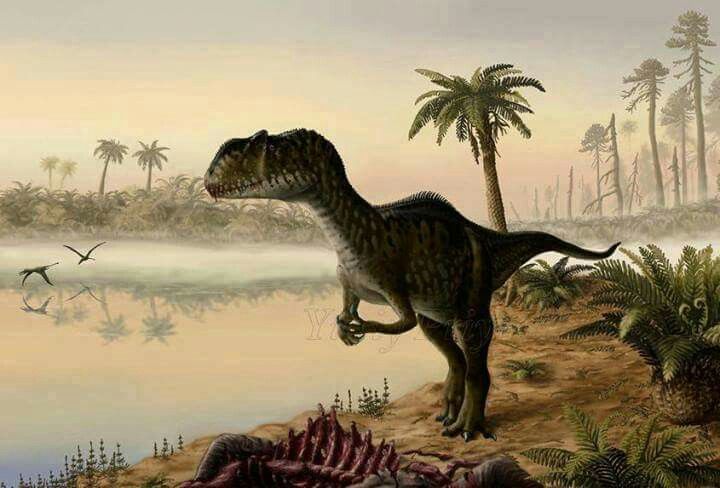
a pair of Huayangosaurus keep a wary eye on a Yuangchuanosaurus
Yangchuanosaurus was the apex predator in its environment. It likely preyed upon sauropods such as Mamenchisaurus and Omeisaurus, and it may have dodged spikes and plates to take down stegosaurs such as Tuojiangosaurus and Huayangosaurus. It was similar in size and appearance to the North American Allosaurus, though it was likely slower (its top running speed has been clocked around 25 miles per hour). Yangchuanosaurus was a large, powerful carnivore that walked on two muscular legs. The first digit of its foot was a small dewclaw, a vestigial toe that generally grows higher on the leg and doesn’t make contact with the ground when walking. The three outer toes bore its weight, and each was armed with a large claw. Yangchuanosaurus  had short arms, a strong but short neck, a big head with powerful large, and large, serrated teeth. Because its jaws were relatively weak in regards to bite force, it may have brought down prey in the same manner as has been suggested for Allosaurus: the ‘hatchet-bite’ technique in which the attacker swings its head down like a hatchet to club or stun its prey to submission. Yangchuanosaurus  had characteristic growth on top of its nose along with smaller horns and ridges, similar to Ceratosaurus. Its tail made up half its length.

Yangchuanosaurus may have hunted in packs like the North American Allosaurus. While direct evidence is lacking, the similarities between the two theropods imply such behavior wouldn’t be surprising. Adding credibility to the theory is that we have two specimens of this dinosaur, and they are of different sizes (the first’s skull is 2.5 feet long, and the second’s is 3.5 feet long; the first grew to 26 feet in length whereas the second grew up to 36 feet in length); while these differences could be attributed to different ages of the specimens, it could also be due to sexual dimorphism. Sexual dimorphism – wherein one sex has different sizes or morphologies than the other – is often seen in gregarious creatures, and pack-hunting is a facet of gregarious hunters (think: wolves). By hunting in packs, Yangchuanosaurus could bring down large sauropods. The meat of a full-grown Mamenchisaurus could feed the pack for a whole week and still leave some leftovers for scavengers. 


Monday, January 09, 2023

Dino of the Week: Xiaotingia

Type Species: Xiaotingia zhengi
Classification: Dinosauria – Saurischia – Theropoda – Coelurosauria – Maniraptora – Paraves – Avialae - Anchiornithidae
Location: China
Diet: Carnivore 

The paravian Xiaotingia was morphologically similar to Archaeopteryx. Xiaotingia was the size of a hen. It was covered in feathers and likely lived an arboreal lifestyle. It had long forelimbs – like Archaeopteryx – and it may have stood on its hind limbs and used its forelimbs for flapping. The feathers on its upper leg were quite long, and it had pennaceous feathers on its lower leg. If Xiaotingia could fly short distance, it likely used its feathered hind legs as ‘hind wings.’ Xiaotingia’s jaws likely held less than ten teeth, and the teeth were similar to those of basal avians. 

the reformation: one year

This past year I went from 161# in May 2025 to 129.8# in April 2026. My goal for the summer is body recomposition, maintaining muscle while ...